The problem

In Mexico and Brazil, more than 80 million adults are unbanked or underbanked. Many shop on Amazon but can’t join Prime, because Prime needs a card that can be charged every month. They needed a way to pay for Prime the way they already pay for everything else: in cash at a store, or through a local payment app.

Members also needed a clear way to renew, change, or cancel. With cash, nothing renews on its own. Every renewal is a trip to a store.

PayCode

PayCode launched in the US in 2017 and later expanded to Mexico. A customer gets a code at checkout, pays for it in cash at a participating store, and the order ships once the payment clears. It was built for one-time orders, not for a membership that renews.

Amazon PayCode in four steps: shop on Amazon.com, choose “Use Amazon PayCode” at checkout, pay in cash at a Western Union agent, and the order ships.

Cash for Prime runs on the same technology as PayCode. Customers who already paid for orders in cash would recognize the flow when they signed up for or renewed Prime. Pix, Brazil’s instant payment system, lets customers pay through another mobile payment app.

My role

I owned the payment experience across Prime’s sign-up flows. I led design for bringing PayCode (Mexico) and Pix (Brazil) into Prime sign-up, renewal, and prepayment, from the first product proposal review through engineering handoff.

I worked weekly with the PM, TPM, and engineers, and with the Payments and verification teams. I left Amazon in September 2023, before launch. Both payment methods shipped using my flows and designs.

Design process

Four-phase design process: discover, define, develop, and deliver. An arrow loops from develop back to define before moving on to deliver.

Discovery and contextual research

I started by auditing the PayCode and Pix flows owned by Amazon’s Checkout and Payments teams, to sort out what Prime could reuse and what it would need to build. I also studied payment models with the same renewal problem: prepaid phone plans, rent and utility payments, and Prime memberships paid with gift cards.

I also mapped how Prime differs between Amazon Mexico and Amazon Brazil. Each market has its own programs, benefits, and technical frameworks.

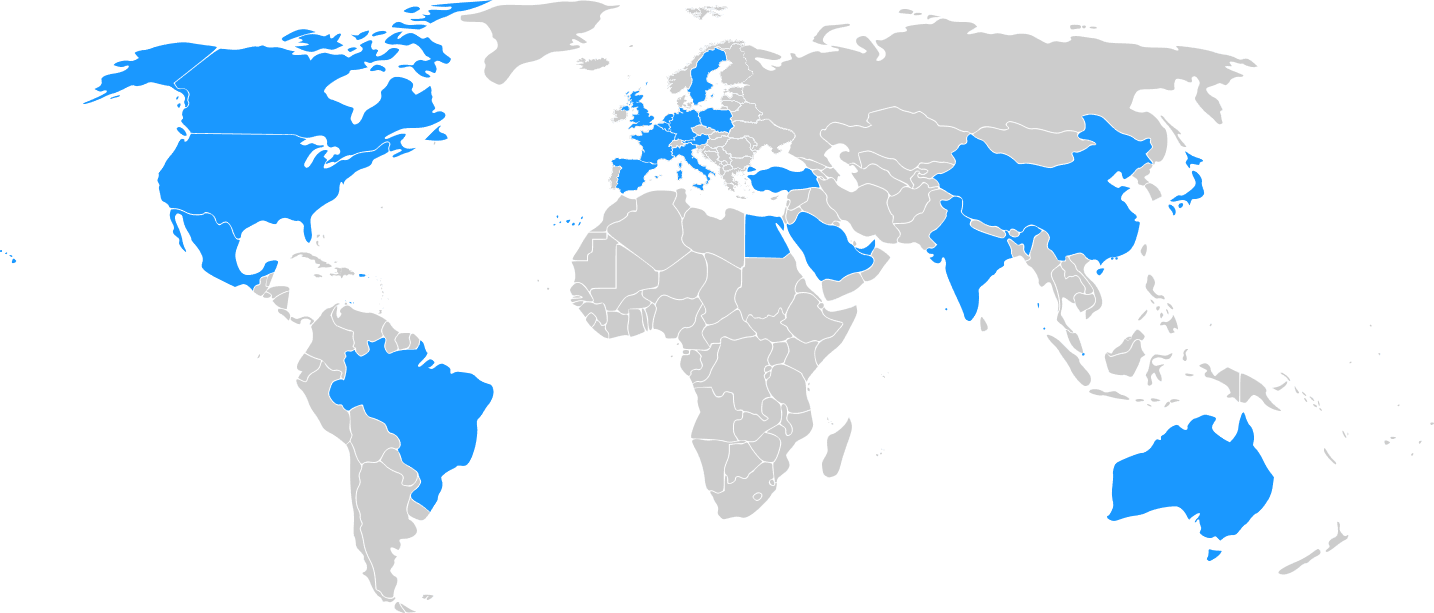
Global quantitative research

In a separate study, our UX research and product teams surveyed Prime members and non-members in several countries about how they pay without cards. It ran alongside design, so the design timeline didn’t wait on its results.
Global quantitative research

Customer journey

We planned three phases: a beta launch and two follow-ups. The beta and the first follow-up defined the full journey: sign-up, renewal, and prepaying ahead.

Acquisition

Customers join Prime and choose to pay in cash or with a local payment app. The flow changes depending on where they start and which offer they get.

Renewal

Members pay each month or year in cash at a store, or through a local payment app. Nothing charges automatically, so reminders do the work a saved card normally does.

Extension

Members prepay for several months at a discounted rate, so they make fewer store trips. Prime hadn’t offered this before. We modeled it on gift card prepayment in other regions.

Storyboard

Half of this journey happens away from a screen. My UX manager and I drew a storyboard of it, from sign-up to paying at a store to becoming a member, so leaders and partner teams could see it. I later reused it to map renewal, including notifications and the wait between getting a code and paying.

Storyboard of a customer joining Prime with cash: starting a 30-day free trial on their phone, choosing to pay with cash, getting a barcode, going to a store, paying at the counter, and seeing the Prime welcome screen.

Customer segments

Sign-up split four ways, based on the offer and where the customer starts.

Each segment needed its own flow. For example, free-trial customers pay nothing up front, so their first barcode comes at renewal. Customers without a free trial pay before their membership starts.

Customer segments

Sign-up split four ways, based on the offer and where the customer starts.

Each segment needed its own flow. For example, free-trial customers pay nothing up front, so their first barcode comes at renewal. Customers without a free trial pay before their membership starts.

Checkout, free trial

Checkout, free trial

A customer at checkout who is eligible for a 30-day free trial.

Checkout, no free trial

Checkout, no free trial

A customer at checkout who is offered Prime but isn’t eligible for a free trial.

Prime page, free trial

Prime page, free trial

A customer on the Prime page who is eligible for a 30-day free trial.

Prime page, no free trial

Prime page, no free trial

A customer on the Prime page who isn’t eligible for a free trial.

Checkout, free trial

Checkout, free trial

A customer at checkout who is eligible for a 30-day free trial.

Checkout, no free trial

Checkout, no free trial

A customer at checkout who is offered Prime but isn’t eligible for a free trial.

Prime page, free trial

Prime page, free trial

A customer on the Prime page who is eligible for a 30-day free trial.

Prime page, no free trial

Prime page, no free trial

A customer on the Prime page who isn’t eligible for a free trial.

User flow

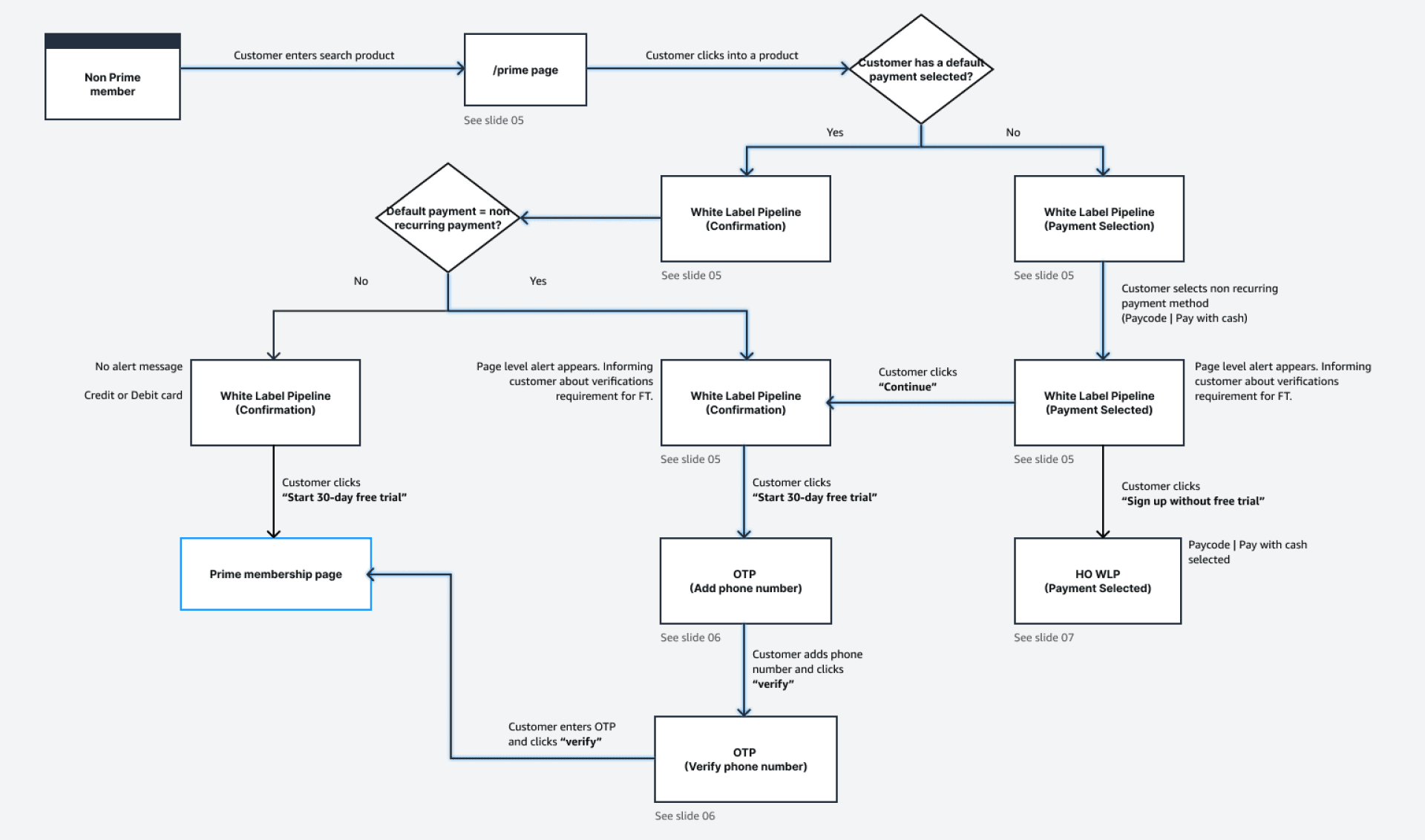
I mapped sign-up from checkout (free trial and no trial), sign-up from the Prime page, and getting a barcode from the Amazon app. The flows showed where customers make decisions, which edge cases needed a design, and where people leave and come back partway through.
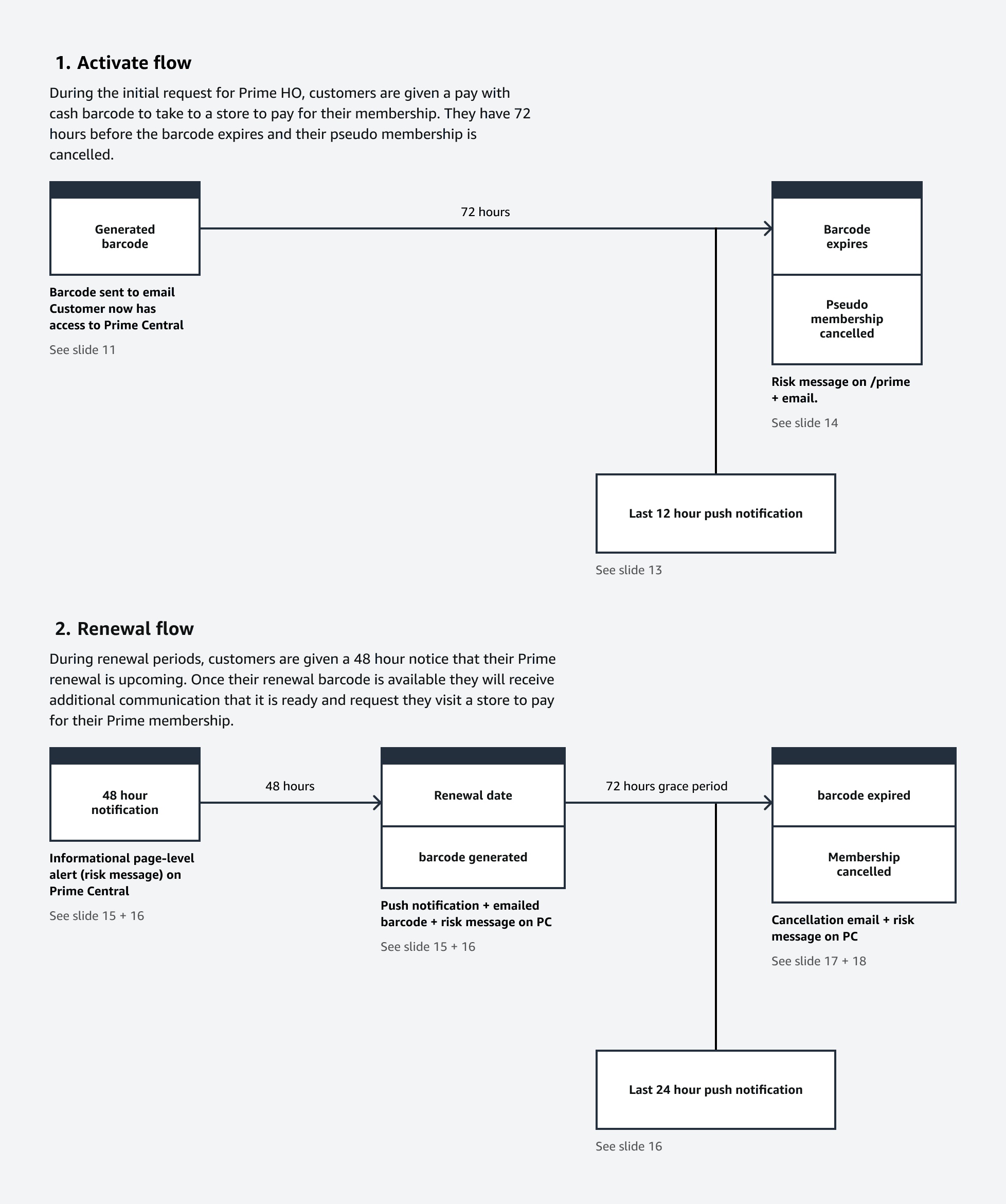
Barcode timing. At sign-up, the customer has 72 hours to pay before the barcode expires and the membership is canceled, with a final push notification in the last 12 hours. At renewal, a notice comes 48 hours ahead, a new barcode on the renewal date, then a 72-hour grace period before cancellation.
User flow for a non-member signing up from the Prime page. Depending on their default payment method, they confirm or choose a payment, and cash payers either verify a phone number to start a 30-day free trial or sign up without one.
User flow for a non-member signing up at checkout. Choosing PayCode leads to the free-trial offer and phone verification, then back to checkout as a Prime member with a PayCode barcode.

Studies

We didn’t run usability tests before development. Recruiting cash-reliant customers in other countries didn’t fit the timeline.

We chose to ship a working beta and improve it after launch, using sign-up data and A/B tests.

Wireframes

With the flows set, I wireframed the mobile experience: sign-up at checkout, renewal notifications, changing payment method, and getting a barcode from the My Prime page. I reworked them with the PM and TPM each week as technical limits and edge cases came up.

Mid-fidelity wireframes of the mobile flows, including a renewal notification, the payment barcode and email, and sign-up screens, linked by arrows.

Challenges

A customer could get a barcode and not reach a store for days. That raised hard questions: when a barcode expires, what happens to membership in the meantime, and how long to wait before canceling.

Lock-screen push notification from Amazon: “Reminder to visit a local store to pay for your Prime membership. Expires in 12 hours.”

I explored four options: extending barcode expiry from three to seven days, a reminder 10 days ahead, a forgiveness period of 14 to 30 days, and renewal prompts on the home page and at checkout. Billing limits ruled most of them out for the beta. We shipped alerts three days before and on the renewal day, by banner, push notification, and email, plus a three-day grace period before cancellation. Text messages weren’t available until later.

Other challenges

Alert explaining that a free trial paid with cash requires verifying a mobile phone number, with options to pay cash without a free trial or use a debit or credit card.

Fraud prevention

A cash free trial is easy to abuse: sign up, use the benefits, never pay. We added a verification step to sign-up, before the barcode is created.

Prime plan settings for a cash-paying member, showing “Plan change unavailable” and a link to add a debit or credit card to change plans.

Changing plans

Cash makes refunds and mid-cycle plan changes slow, and the beta’s billing couldn’t support them. We shipped without them and added credit and advance stacking (applying prepaid months on top of an active membership) in the next two phases.

Amazon.com.mx “Pay with cash” options: pick up and pay at a store, or pay at a store and have the order shipped, with three steps for paying by barcode.

Technical challenge

PayCode ran on legacy APIs that were never built for recurring payments, and several teams owned the pieces. There was no “waiting for payment” state for a membership. Prime had to be set up as a purchasable product. Refunds for prepaid months had no path, and the legacy framework made accessibility compliance harder. Each gap meant a compromise in the flow, worked out with the Payments, verification, and Prime engineering teams.

Mobile to desktop

Our data showed that cash-paying members were more likely to manage their membership on desktop or tablet. So I designed the desktop versions of the payment selection, store list, barcode, and My Prime pages alongside mobile, not after it.

Desktop and mobile screens for paying with cash, from payment selection and the store list to the barcode email and the My Prime page with the current plan.

Impact

PayCode for Prime (Mexico) and Pix for Prime (Brazil) launched between late 2023 and early 2024, opening Prime to customers without a bank card. The same flows now support Prime Video–only memberships, which the Prime Video team manages. Launch results are under NDA.

We built the framework so other emerging markets could add local payment methods without starting over. India was next on the list.

Order confirmation on desktop and mobile: the order and Prime membership are reserved, with a barcode to pay at a participating store within 72 hours.

Learnings

Payment habits vary by region more than I expected. Some countries are moving fast to digital banking and contactless payment. Others still run on cash, because of habit, limited access, or distrust of banks.

Legacy payment systems shape the design more than any mockup does. The ideal flow often couldn’t be built, so I learned to bring engineering several workable options instead of one.

If I did it again, I’d push for research with cash-reliant customers much earlier. Without their voices, we relied on proxy data to guess how they’d think and behave.

Interested in this project?

Want to see the full flows or talk through the renewal tradeoffs?